RGUHS Nat. J. Pub. Heal. Sci Vol No: 12 Issue No: 2 pISSN: 2249-2194
Dear Authors,
We invite you to watch this comprehensive video guide on the process of submitting your article online. This video will provide you with step-by-step instructions to ensure a smooth and successful submission.
Thank you for your attention and cooperation.
1Dr. Rohit V Chavan, PG Scholar, Department of Kaumarbhritya, Parul Institute of Ayurveda and Research, Vadodara, Gujarat, India.
2Department of Kaumarbhritya, Parul Institute of Ayurveda and Research, Vadodara, Gujarat, India
3Department of Kaumarbhritya, Parul Institute of Ayurveda and Research, Vadodara, Gujarat, India
4Department of Kaumarbhritya, Parul Institute of Ayurveda and Research, Vadodara, Gujarat, India
5Department of Kaumarbhritya, Parul Institute of Ayurveda and Research, Vadodara, Gujarat, India
*Corresponding Author:
Dr. Rohit V Chavan, PG Scholar, Department of Kaumarbhritya, Parul Institute of Ayurveda and Research, Vadodara, Gujarat, India., Email: rohitchavan0312@gmail.com
Abstract
Herpes zoster (Shingles) can be correlated with Visarpa, an Ayurvedic condition characterized by rapidly spreading rashes and pain. This case report describes a 16-year-old male who presented with fever, burning sensation, and a reddish lesion on lumbar region of the left lateral abdominal wall. Initially, he applied neem paste, which exacerbated his condition, leading to vesicular rashes and increased discomfort. Diagnosed with herpes zoster, the patient was treated with internal medications including Kamdudha Rasa, Gandhak Rasayan, Arogyavardhini Vati, and Patolkatukrohinyadi Kashaya. Local applications included Dashanga Lepa and Shatdhouta Ghrita. After 11 days, symptoms such as fever, redness, burning sensation, and pain had reduced. Ayurvedic treatments focusing on Pitta balancing and blood purification, particularly Shatdhouta Ghrita mixed with Panchavalkala powder, provided significant relief.
Keywords
Downloads
-
1FullTextPDF
Article
Introduction
Herpes zoster, or shingles, is considered to be related to Visarpa due to similarities in both clinical manifestations and how the disease occurs.1 Herpes zoster is caused by the Varicella zoster virus, which also causes chickenpox. The herpes zoster rash typically appears in a band-like pattern on one side of the body, reflecting the characteristic spread described in Visarpa.
The incidence of herpes zoster ranges from 5.2 to 10.9 cases per 1000 person-year.2 Herpes zoster is caused by the Varicella zoster virus. Since its transmission can occur rapidly, the first priority of medical management should be to control its spread.
In Ayurveda, this disease is referred to as Visarpa, though the term Parisarpa is also used. It is characterized by rapid spread and involvement of multiple tissues, including Rakta (blood), Lasika (lymph), Twak (skin), and Mamsa (muscles). The pathogenesis of Visarpa involves Vata, Pitta, and Kapha doshas.3
Case Report
A 16-year-old male patient presented to the Kaumar-bhritya Department OPD at Khemdas Hospital (OPD No.: 24027394) on 17/09/2024, with complaints of fever and a reddish skin lesion over the lumbar region of the left lateral abdominal wall, associated with burning sensation and pain for the past 3-4 days.
History of Presenting Complaint
Three days prior, the patient was in his usual state of health. He then developed a mild burning sensation in his lumbar region of the left lateral abdominal wall.
Soon after, the area became erythematous and a lesion appeared. As a home remedy, he applied a paste prepared from neem leaves.
By the third day, his condition had worsened. The lesions began to transform into vesicles, and the itching, pain, and burning sensation intensified. Sun exposure and sweating further aggravated the discomfort.
History of Past Illness
No significant past history was reported.
Family History
All family members are reported to be healthy, with no history of autoimmune, genetic, or dermatological disorders.
Treatment History
No significant treatment history was noted.
Personal History
Ahara - Vegetarian diet, taken three times per day.
Vihara - Vata and Atapa.
Nidra - Prakrut: 8-10 hours per day.
Asthavidha Pariksha
1. Naadi - Vata Pitta.
2. Mala - Prakrut 1-2 times/day.
3. Mutra - Prakrut 3-4 times/day, 0-1 times/night.
4. Jivha - Niram.
5. Sparsha - Ushna Sparsha.
6. Shabdha - Spashta (clear voice).
7. Drik - Prakrut.
8. Akruti - Madhyam.
Dashavidha Pariksha
1. Prakruti - Pittakapha
2. Vikruti - Pitta Pradhan Tridosha Vikruti
3. Satwa - Pravara
4. Saara - Pravara
5. Samhanana - Madhyam
6. Ahara Shakti - Abhyavaharana Shakti - Madhyam
7. Jarana Shakti - Madhyam
8. Vyayama Shakti - Madhyam
9. Satmya - Madhyam
10. Pramana - Madhyama, Weight- 38 kg, Height- 145 cm, BMI -18.1
11. Vaya - Kumara
Samrapti Ghataka
Dosha - Pitta Pradhantridosha.
Dushya - Rasa, Rakta, Mamsa.
Srotodushti - Rasavaha, Raktavaha, Mamsavaha.
Sadhyasadyata- Yaapya.
General Examination
Gait - Normal
Pallor - Absent
Icterus - Absent
Cyanosis - Absent
Oedema - Absent
Lymph nodes - Not palpable
Systemic Examination
Respiratory system: Bilaterally symmetrical; clear
Cardiovascular system: S1, S2 heard; no added sounds
Central nervous system: Conscious and well-oriented; superficial reflexes intact
Gastrointestinal tract: Bowel movements regular; tongue coated
Per abdomen (P/A): Soft and non-tender
Skin Examination
Pidaka: Grouped rashes with fluid-filled blisters (vesicles) on a reddish base
Area: Lumbar region of the left lateral abdominal wall
Colour: Reddish
Odour: No specific odour
Secretion: Absent
Pain: Occasional mild pain
Itching: Present
Burning sensation: Present
Tendency to bleed: Absent
Loss of sensation: Absent
Vital Examination
Pulse rate: 92 /min
Respiratory rate: 20 /min
Temperature: 99.6°F
Investigations
Complete blood count (CBC) and C-reactive protein (CRP) tests were performed, and all results were within normal limits.
Diagnostic Assessment
The patient presented with clusters of vesicles on the left lateral abdominal wall. Initially, the rash appeared as vesicles accompanied by itching and a preceding burning sensation, with symptoms progressively worsening over time. Similar features are described in Ayurvedic texts under Pittaja Visarpa, which includes symptoms such as Sphotabahulta (appearance of vesicles), Daha (burning sensation), and Sambheda (pain).4
Differential Diagnosis
• Chicken pox (Masurika)
o Inclusion Criteria: Vesicular eruptions with watery blisters
o Exclusion Criteria: No history of fever, localized restricted rash
• Shitapita
o Inclusion Criteria: Sudden onset red wheals, intense itching, elevated patches; symptoms relieved by cold and aggravated by heat
o Exclusion Criteria: Absence of vesicles/blisters, no fever or burning, non-successional, non-fluid lesions
• Kustha
o Inclusion Criteria: Redness, itching
o Exclusion Criteria: No chronicity, absence of scaling or thickened skin
• Visarpa
o Inclusion Criteria: Rapidly spreading fluid-filled blisters, shiny inflamed skin, redness, burning, and itching
The patient’s symptoms align with Visarpa, as evidenced by the rapidly spreading fluid-filled vesicles, redness, itching, and shiny appearance, which are not typical of Masurika, Shitapita, or chronic Kustha. The acute progression and vesicular nature strongly support Visarpa as the most appropriate diagnosis.
According to Ayurveda
Clinical features such as Sphotabahulta (appearance of vesicles), Daha (burning sensation), and Sambheda (pain) correspond with the lakshanas of Pittaja Visarpa.
The therapeutic regimen was structured in a stepwise manner to address Pitta imbalance and promote healing. The therapeutic regimen was structured in a stepwise manner to address Pitta imbalance and promote healing (Table 1).
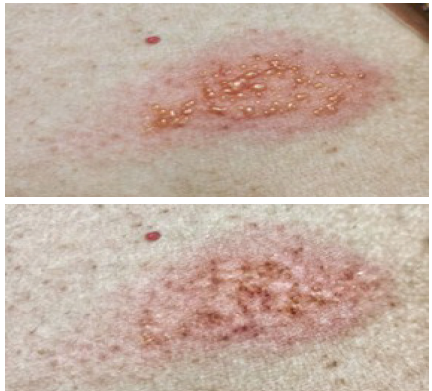
Clinical improvement was visually evident, as shown in the lesion images before and after treatment (Figure 1)
Timeline
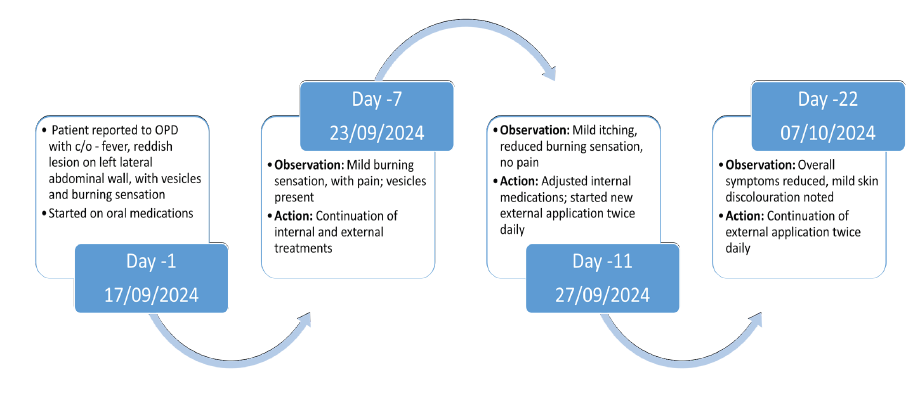
The overall clinical course and interventions are illustrated in the timeline of the patient’s recovery (Figure 2)
Case Progress
The patient first presented on 17/09/2024 with fever, a reddish patch, burning sensation, and vesicular eruptions on the left lateral abdominal wall. Oral medication was initiated to reduce inflammation and relieve symptoms. After one week, on 23/09/2024, the patient showed gradual improvement with reduced burning, although vesicles were still present; therefore, the same line of treatment was continued. By 27/09/2024, pain had completely subsided, with only mild itching remaining, indicating notable improvement. At this stage, internal medications were adjusted and a new external application was introduced to further promote recovery. On 07/10/2024 (Day 22), the patient displayed significant improvement with resolution of vesicles and only mild residual skin discolouration. Continued external application was advised to support complete restoration of the skin. Overall, the case demonstrated steady progress and symptom reduction with consistent therapeutic response.
Discussion
Kamadudharasa is a classical Ayurvedic preparation known for its Pitta-pacifying properties.5 It is prepared using Amalaki juice, Guduchi extract, Swarna Gairika, along with cow's ghee. The hydrolysable tannins present in Amalaki possess antimicrobial, anti-inflammatory, and immunomodulatory actions. Guduchi, being rich in saponins and triterpenoids, exhibits antiviral properties, and is particularly beneficial in herpes. Swarna Gairika helps regulate metabolism and provides antioxidant effects, making Kamadudharasa effective in Pitta imbalance conditions such as fever and herpes zoster.
Arogyavardhini Vati is indicated in Kustha, Medo-dosha, Yakrit-vikara, and chronic fever. It supports toxin metabolism and helps correct imbalances in the Rasa dhatus.6
Tikta Rasa is crucial in the treatment of Pitta Dosha disorders due to its Pittashamaka and Amapachana effects. Its Vayu and Aakasha composition render it Laghu, Ruksha, and Lekhana properties that contribute to the removal of cellular obstructions, facilitating efficient passage of nutrients, and soothing Kapha and Pitta, thereby exerting antipyretic and detoxifying actions. In Patolkatukrohinyadi Kashaya, components in Tikta Rasa such as Patola and Guduchi help reduce moisture content, purify the blood, and decongest the liver, thereby effectively managing Visarpa-related conditions.7
Gandhak Rasayana is used primarily for skin disorders, mainly for acne and eczema.8 In Visarpa, it acts by purifying the blood, reducing Pitta-Rakta issues, and improving immunity. Its antimicrobial and anti-inflammatory properties help control infection, redness, and swelling, while its antiparasitic action inhibits microbial growth. As a Rasayana, it strengthens skin tissues, accelerates wound healing, reduces scarring, and prevents recurrence, thereby ensuring faster recovery and restoration of healthy skin. Topically, Dashanga Lepa and Shatdhouta Ghrita with Panchavalkal powder are used to support wound healing in herpes.9,10,11 The astringent, cooling, and cleansing properties of Panchavalkal reduce inflammation, oozing, and microbial load in Visarpa, while the cooling, penetrating, and healing actions of Shatdhouta Ghrita’s pacify Pitta, soothe burning, and promote tissue repair. Together, they limit the spread, cleanse the lesions, prevent infection, and accelerate healing with minimal scarring.
In this case study, the primary factors inducing Visarpa or herpes zoster were vitiated Pitta and Rakta. The patient initially experienced a few rashes accompanied by herpetic pain and a burning sensation lasting for two days. During the course of treatment, the symptoms (size and number) showed aggravation for 3-4 days. However, by the 6th or 7th day, the symptoms had begun to decline and had fully resolved by the 21st day.
This case illustrates that a stepwise treatment approach can be effective in treating Visarpa. The therapeutic regi-men employed Tikta Rasa dravya (bitter substances), sometimes in association with Rakta Shodaka dravya (blood-purifying substances), along with topical application of cooling and drying pastes. It is indeed noteworthy that the patient was administered only Ayurvedic medicines and was not given antiviral medication. The positive outcome supports the efficacy of Ayurvedic therapies in the management of Visarpa.
Conflict of Interest
Nil
Supporting File
References
1. Mohan H. Textbook of pathology. New Delhi: Jaypee Brothers Medical Publishers; 2015. p. 177.
2. Giannelos N, Curran D, Nguyen C, et al. The incidence of herpes zoster complications: A systematic literature review. Infect Dis Ther 2024;13:1461-1486.
3. Tripathi B. Charaka Samhita of Agnivesha. Edited with Charaka-Chandrika Hindi Commentary. Chikitsasthana, Chapter 21, Verse 13-15, Vol II. Varanasi: Chaukhamba Surbharti Prakashana; 2015. p. 707-708.
4. Acharya BT. Chikitsa Sthana Charaka Samhita of Agnivesha. Chapter 21, Verse 32. Varanasi: Chaukhamba Surbharti Prakashana; 2004. p. 711.
5. Rastantrasara VA. Siddhaprayoga Sangraha, Part- 1, Kharaliya Rasayana. Ajmer: Krishna Gopal Ayurveda Bhavan; 1980. p. 444-5.
6. Singhal P, Nesari T, Gupta GS. Efficacy of herbomineral compounds and pathya (Ayurvedic dietary regime and physical exercise) in the management of Yakrt Roga (non-alcoholic fatty liver disease). Anc Sci Life 2015;34:216-22.
7. Vaidya H. Ashtanghridayam of Acharya Vagbhata, Tikakara Manindra Kumar Vyasa. Sutrasthan: Chapter 15, Verse 15. 1st edition. Varanasi: Chaukhamba Vishvabharti; Reprint 2019. p. 189.
8. Lakshmipathi Shastri. Rasayandhikara. In: Yogaratnakara. Varanasi: Choukambha Sanskrit Sansthan Prakashan; 1983; p. 501.
9. Kumari A, Tiwari PV, Editor. Yogratnakar Samhita, Part 2. Chapter 58, Verse 38. Varanasi: Chaukhamba Vishvabharti, Oriental Publisher; 2010.
10. Kumari A, Tiwari PV, Editor. Yogratnakar Samhita, Part 2. Chapter 58, Verse 42. Varanasi: Chaukhamba Vishvabharti, Oriental Publisher; 2010.
11. Shastri BS, Editor. Visarpa Chikitsa. In: Commentary Vidyotini Hindi of Shastri Laxmipati on Yogaratanakara. Uttaradhra: Verse 2. 4th ed. Varanasi: Chowkhamba Sanskrit Sansthan; 1988. p. 246.